

Plan Your CBL Course
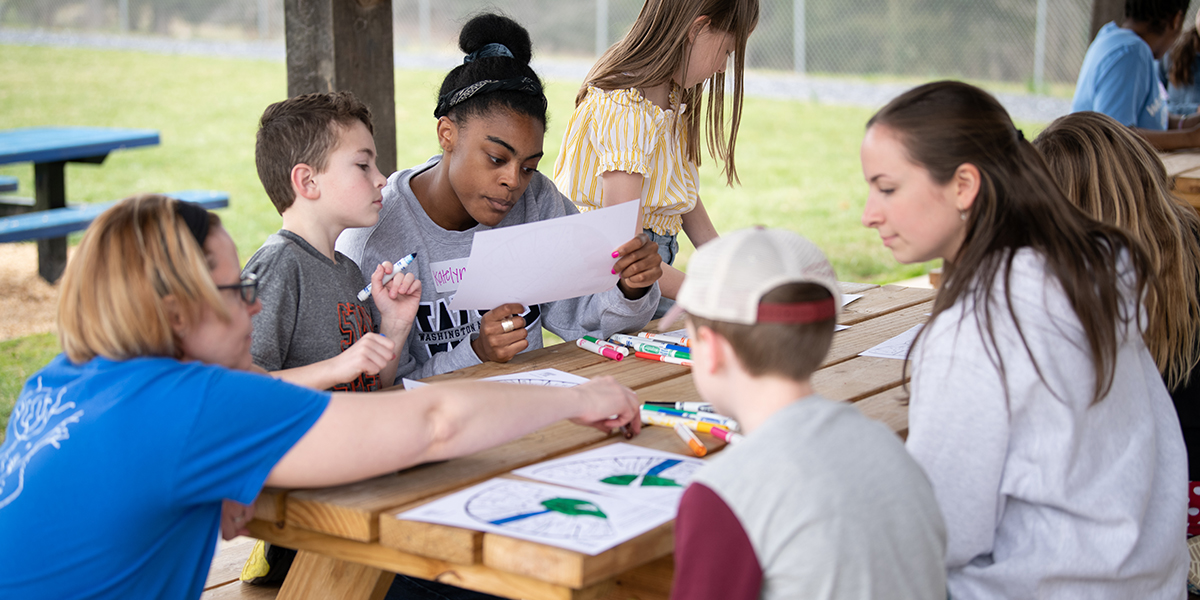
CBL Course Types
There are four ways your class could engage in collaboration with a community partner.
Faculty and community partners place students at sites where they serve the mission of the organization while also applying and extending their knowledge and skills. Students relate community-based service experience to learning objectives using structured reflection and learning activities.
Outcomes of recent site-based courses
In ECON 235: Economics of Social Issues, students engaged with numerous local agencies including childcare centers, nursing homes, and food pantries. Students expanded their understanding of real-world economics within the context of aging, food security, education, and other dimensions of society.
In BIO 275: Food for Thought, some students engaged with Campus Garden and Campus Kitchen. By participating in gardening and food recovery shifts, students witnessed the cyclical, multidimensional nature of local food systems firsthand.
Students, faculty, and community partners collaborate on a project with the purpose of addressing a community-defined interest or aspiration. Community partners and faculty are involved in all stages of the project, including participating in the design and implementation of the project and shaping the final deliverable product.
Outcomes of recent project-based courses
In FILM 238: Documentary Filmmaking, students and faculty partnered with a local domestic violence/sexual assault agency that offers educational services as well as a shelter and hotline. The team created a documentary about the advocacy work of that organization.
In ENGN/PHYS 378/379, some Engineering capstone students conducted a traffic study in partnership with the City of Lexington. After the study was complete, the students proposed traffic pattern changes to the City.
Students, faculty, and community partners collaboratively engage in research with the purpose of addressing a community-defined interest or aspiration. Community partners and faculty are involved in all stages of the research project, including defining the research question, participating in the design and implementation of the project, and shaping the final deliverable product.
Outcomes of recent CBR courses
In CBSC 413, two senior capstone students partnered with regional leadership working to address homelessness. Students collected and analyzed quantitative data and shared the outcomes with their community partners.
In ENV 111, some students partnered with a local childcare facility. Students conducted research on how to create sustainable playgrounds and presented the information, alongside their recommendations, to their community partner.
Students join faculty and learning partners from the wider community to read, discuss, and learn together about a topic of broad social relevance. This model, increasingly common within the context of correctional institutions, may also include other community partners and typically occurs off-campus.
Outcomes of recent community-partnered seminars
There are currently three W&L courses (in BUS, POV, and SOAN) taught annually by W&L faculty and held at Augusta Correctional Center. These community-partnered seminars bring together W&L students and individuals who are incarcerated to study topics including: team dynamics (BUS), identity construction (SOAN), and justice and mercy (POV).
Student Learning Outcomes
Three Required Outcomes
CBL courses have three particular learning outcomes that were co-created by faculty, staff, and community partners invested in community engaged teaching and learning.
- Analyze the mission, structure, and work of community partners in addressing the public good.
- Collaborate effectively and respectfully with community-based learning partners, faculty, students, and/or other stakeholders to meet community-defined aspirations and interests.
- Integrate classroom learning experiences with community learning experiences.
Choose an Additional Outcome
Incorporate at least one of these additional CBL learning outcomes:
- Articulate how community-based learning contributes to the evolution of students’ personal, professional, academic, and/or civic identities.
- Identify and critically examine perspectives and experiences different from the student’s own in order to understand the interrelationships between and among multiple perspectives (e.g. race, gender, socioeconomic status, disciplinary background) as well as the role of the university in the community.
Download a printable version of the CBL Course Standards. These standards, which all CBL courses adhere to, were co-created by faculty, staff, and community partners invested in community engaged teaching and learning.
Every year the Office of Community-Based Learning collects feedback from faculty, students, and community partners regarding the effectiveness of community-based learning courses. Review feedback from the 2024-2025 Academic Year.
Additional Resources
Course Planning Calendar
Important steps to consider when creating a CBL course.
CBL Course Designation
CBL course designation criteria were co-created by faculty, staff, and community partners based on nationally recognized best practices. Before seeking designation, please consult with the Office of Community-Based Learning.
CBL Course Codesign Grant
The Office of Community-Based Learning (CBL) accepts proposals from faculty and instructors interested in integrating community-based learning into a new or existing course. The purpose of this grant is to support teams, consisting of both faculty and community partner(s), in the collaborative design or redesign of a course.
CBL Community Partners
CBL collaborates with a variety of local and regional community-based organizations. If you would like to connect with these organizations, please contact the office of Community-Based Learning.
CBL Teaching Assistants
Students serve as CBL Teaching Assistants within CBL-designated courses to offer faculty critical support for coordinating student community engagement experiences and quality service.
Sascha Goluboff
Director of Community-Based Learning and Professor of Cultural Anthropology
- Hopkins House 207
Alessandra Del Conte Dickovick
Associate Director of Community-Based Learning
- Hopkins House 204
Bethany Ozorak
Associate Director of Community-Based Learning
- P: 540-458-4130
- E: bozorak@wlu.edu
- Hopkins House 201
Office of Community-Based Learning
- P: 540-458-8386
-
Washington and Lee University
Hopkins House
120 W Nelson St
Lexington, Virginia 24450