
Environmental Studies
- Degree Type Bachelor of Arts
- Department Interdisciplinary
- Academic Division The College
- Offerings Major Minor
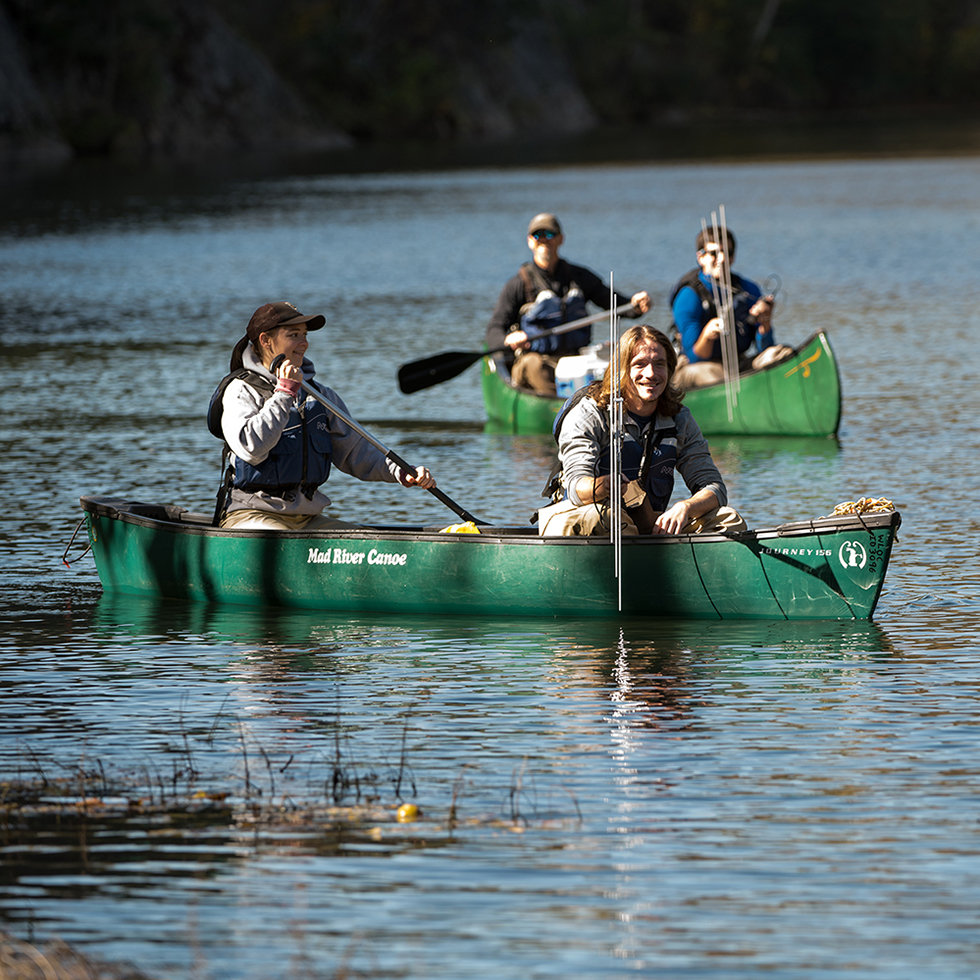
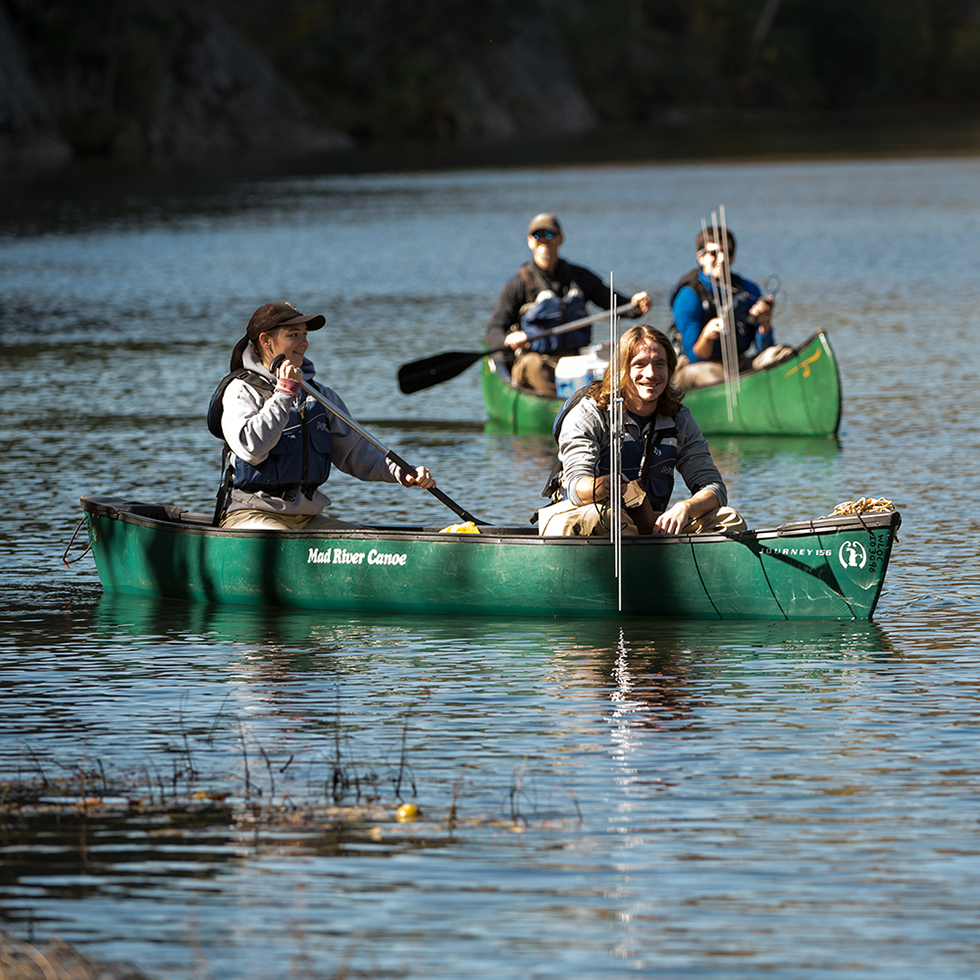
Environmental Studies is a holistic approach to studying interactions between humans and the natural environment. This interdisciplinary program comprises core courses augmented by courses in the humanities, social sciences and natural sciences. A culminating capstone experience draws upon this diversity of coursework to examine causes, consequences and solutions to environmental problems.
Why Study Environmental Studies at W&L?
- The curriculum draws on the strengths of W&L faculty across several departments and the outstanding natural setting of Lexington to offer a truly unique undergraduate experience with an emphasis on place-based learning.
- The faculty are accomplished scholars and teachers from diverse environmental disciplines. Students can take courses in applied ecology, environmental economics, Native American culture and anthropology, geology and eco-writing, among other topics.
- Interdisciplinary courses put professors from different departments in the classroom together. They demonstrate how their respective fields are brought together to better understand the nature of environmental problems and their solutions. Philosophers team with ecologists, economists with anthropologists, and so on.
- We emphasize place-based learning, putting course subjects in context with the local environment; examples include examining how land use around Lexington influences the health of the Chesapeake Bay coastal ecosystem, traveling to South Dakota to study how culture and economics intersect in the history of the Lakota people, or studying ecotourism in Central America.
- Our study abroad program in Brazil offers immersive experiences where students learn about human-environment relationships in a uniquely different cultural, political, economic and ecological setting.
- The capstone experience encourages students to complete independent research or work as part of a collaborative team to study a particular environmental issue from an interdisciplinary perspective and offer insightful, often creative solutions.
Opportunities
Collaborative research with faculty: Students can work with program faculty on applied environmental research during the academic year for credit or as paid research fellows during the summer months. Students often travel to national or international conferences to present their research and co-author publications with faculty in peer-reviewed journals.
U.S.-Brazil Exchange Program: In this six-month or one-year cultural immersion experience, students learn Portuguese, live in Brazil, take courses and perform research related to energy and the environment.
Internship opportunities: Faculty grants and collaborative research have led to student summer internships with the U.S. Geological Survey, National Oceanographic and Atmospheric Agency, Virginia Department of Environmental Quality and similar offices. The A. Paul Knight Fellowship program offers internships with the Henry’s Fork Foundation in Idaho and the Nature Conservancy.
After W&L
Environmental Studies alumni have gone on to work in a variety of fields including environmental consulting, alternative energy industries, corporate environmental sustainability, federal and state environmental agencies, legal services, education and academia.
We cultivate connections with our alumni to offer opportunities for students to learn from their experiences and expand their professional networks.
“The Environmental Studies Department taught me to think more holistically about the connections between social justice and science, as well as how the environment shapes every aspect of human life.”
Kerriann Laubach
Class of 2013, ’16L
Three W&L Students Awarded Boren Scholarships for Global Language Study
With the scholarship, the graduating seniors will conduct intensive language studies in Indonesia and Japan.
W&L’s Tom Finnegan ’26 Awarded U.S. Teaching Assistantship to Austria
Finnegan is looking forward to sharing his passion for sustainable food systems with the students at a “green” school near Klagenfurt am Wörthersee.

W&L’s Molly Biggs ’26 Earns Fulbright to Germany
Biggs is looking forward to teaching English in Germany, where she can build on previous youth leadership experiences and develop important skills for a career in the climate sector.
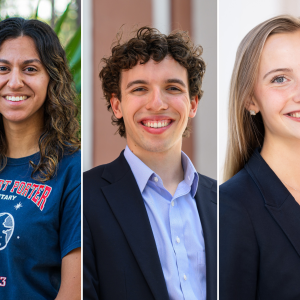
W&L Alumni and Student Awarded NSF Fellowships
Oriana Gutierrez ’24, Connor Lafo ’26 and Gabrielle Ursin ’25 have received pre-doctoral graduate research fellowships from the National Science Foundation to support their research.
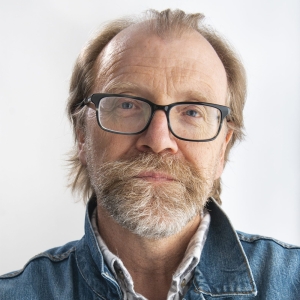
POSTPONED | W&L Hosts 21st Annual Tom Wolfe Weekend
The weekend’s seminar will feature award-winning author George Saunders discussing his new novel, “Vigil.”
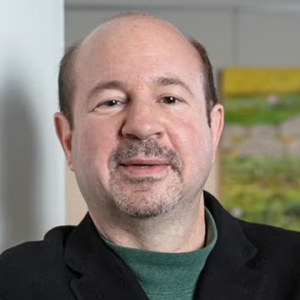
W&L Presents Author and Climate Scientist Michael Mann
The Presidential Distinguished Professor of Earth and Environmental Science from the University of Pennsylvania will discuss his new book, “Science Under Siege,” on March 4.
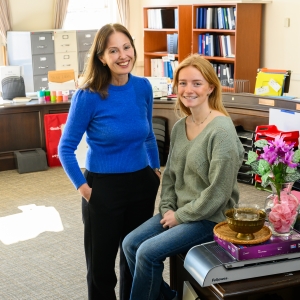
W&L Exchange: A Campus Resource for Sustainable Sharing
The Exchange connects the university community with free supplies while reducing waste.
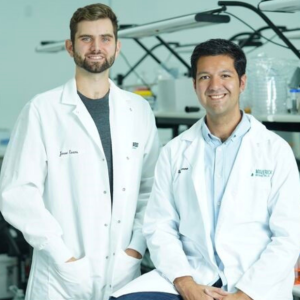
Refining an Industry
Eric Herrera ’20 was recently named to the 2026 Forbes 30 Under 30 list for his work with chemical manufacturing startup MaverickX, which he cofounded with Jesse Evans ’20.

Mauricio Betancourt Co-Authors Article in the Environment, Development and Sustainability Journal
The assistant professor of environmental studies served as the first author for a paper titled “Revisiting sustainable development: a time-series, cross-national study of the nexus between human well-being and environmental impact.”


W&L Alumni Receive Omicron Delta Kappa Scholarship
Two Washington and Lee University graduates received scholarships from the National Leadership Honor Society to support graduate and professional study.

Benjamin Backer is the Next Speaker in the Mudd Lecture Series
Backer, founder and CEO of Nature is Nonpartisan, will give a lecture on Oct. 28 in Stackhouse Theater.
Meet the Faculty
At W&L, students enjoy small classes and close relationships with professors who educate and nurture.

Robert Humston
John Kyle Spencer Director for Environmental Studies and Professor of Biology
- P: 540-458-8341
- E: humstonr@wlu.edu
Humston teaches Introduction to Environmental Studies, Aquatic Ecology and Ecological Modeling, among other courses. He has researched fisheries management, fish ecology and dispersal/movement behavior of animals and plants.

Mauricio Betancourt
Assistant Professor of Environmental Studies
Betancourt teaches Intro to Environmental Studies, Environmental Sociology, and the Commodification of Nature. His research has focused on agroecology, nature-society interactions, imperialism, and unequal ecological exchange.

Jamie Casey
Professor of Economics
- P: 540-458-8102
- E: caseyj@wlu.edu
Casey is a 1991 W&L graduate who teaches courses that focus on the relation between the economy and the environment. His research centers on environmental funding and the economics of agriculture.

Lisa Greer
Harry E. and Mary Jayne W. Redenbaugh Term Professor Department of Earth and Environmental Geoscience and Core Faculty Member in Environmental Studies
- P: 540-458-8870
- E: greerl@wlu.edu
Professor Greer teaches general geology, global climate change, oceanography, history and evolution of the earth, and sedimentation and stratigraphy. She is a core member of the environmental studies faculty. She has spent years researching the health, abundance and history of the endangered Staghorn coral in the Caribbean.

Bill Hamilton
John T. Perry Professor of Biology
Hamilton teaches courses in biology and environmental studies, such as Yellowstone Ecology and Experimental Botany. His research pertains to ecosystem dynamics with a focus on animal-plant-soil interactions in Yellowstone National Park.

Andrew Hess
Associate Provost for Academic Development and Operations and Professor of Business Administration
- P: 540-458-8346
- E: hessa@wlu.edu
Hess is a 1997 alum who researches and teaches in areas of social innovation, strategy and international business. Before returning to W&L, he worked for Fleet National Bank and Silicon Valley Bank in Boston.

Megan F. Hess
Class of 1960 Professor of Ethics and Accounting
- P: 540-458-8370
- E: hessm@wlu.edu
Hess is a 1997 alumna who teaches courses in auditing, accounting ethics and corporate sustainability. Before becoming a professor, she spent 12 years working in the industry with a focus on investigating financial statement fraud.

Ryan McCoy
Assistant Professor of Environmental Studies
- P: 540-458-8252
- E: rmccoy2@wlu.edu
Prof. McCoy is a philosopher whose research focuses on social and ethical problems in climate change research and policy, as well as community-based approaches to address these challenges. He teaches Food Ethics, Environmental Humanities, Environmental Justice, and Introduction to Environmental Studies.

Catarina Passidomo
Associate Professor of Environmental Studies
Passidomo is a human geographer whose research focuses on food systems and the relationships among food, place, nature, society, and power. She teaches Food, Place, and Power; Introduction to Environmental Studies; the Capstone seminar; and other courses in Environmental Studies.