
Engineering
- Degree Type Bachelor of Science
- Department Physics and Engineering
- Academic Division The College
- Offerings Major


Engineering majors at W&L have a distinctive opportunity to study the principles and applications of engineering within a liberal arts environment. Students develop a broad background in engineering fundamentals while they explore the field, and the flexibility of the curriculum allows them to focus on specific interests. Our engineering students develop the ability to think critically and ethically, communicate clearly, appropriately apply engineering principles, and successfully design solutions to real-world problems as they prepare for opportunities after graduation.
Engineering
The Physics and Engineering Department offers a major in engineering.
Students develop depth and breadth in engineering analysis and prepare for careers in a wide range of areas such as mechanical, civil, aerospace, chemical, industrial, environmental, and biomedical engineering.
Student Outcomes
Student outcomes describe the knowledge, skills, and behaviors students are expected to develop and demonstrate by graduation. The Engineering Program at Washington and Lee is pursuing ABET accreditation and has therefore adopted ABET’s student outcomes as guiding principles.
By completing the Engineering Program at Washington and Lee, graduates will have demonstrated the following attributes:
- An ability to identify, formulate and solve complex engineering problems by applying principles of engineering, science and mathematics.
- An ability to apply engineering design to produce solutions that meet specified needs with consideration of public health, safety and welfare, as well as global, cultural, social, environmental and economic factors.
- An ability to communicate effectively with a range of audiences.
- An ability to recognize ethical and professional responsibilities in engineering situations and make informed judgments, which must consider the impact of engineering solutions in global, economic, environmental and societal contexts.
- An ability to function effectively on a team whose members together provide leadership, create a collaborative and inclusive environment, establish goals, plan tasks and meet objectives.
- An ability to develop and conduct appropriate experimentation, analyze and interpret data, and use engineering judgment to draw conclusions.
- An ability to acquire and apply new knowledge as needed, using appropriate learning strategies.
Program Educational Objectives
Program Educational Objectives describe what graduates are expected to accomplish within a few years after graduation. The Program Educational Objectives were developed and approved by the faculty of the Engineering Program.
The Engineering Program at Washington and Lee University fosters a liberal arts approach to engineering so that our graduates are prepared to:
- Utilize a process-driven approach, apply their knowledge of engineering principles and techniques to challenges faced in their professional career.
- Pursue and implement solutions for the betterment of society by responsibly engaging with their team and a diverse range of stakeholders while remaining vigilant of the health, safety, and welfare of the public.
- Critically analyze and integrate into a solution a broad range of cultural, environmental, social, and economic factors that impact the evolving needs of society.
- Adapt to new challenges and opportunities encountered by seeking new foundational principles and techniques as well as the perspective of those involved with and affected by the solution.
About Accreditation
Washington and Lee has begun the process of securing ABET accreditation for our Engineering Program. The certification process is anticipated to allow members of the Class of 2030 to be the first to earn an accredited degree. Elements of the revised curriculum will be available beginning Fall Term 2026. The restructured curriculum will not disrupt W&L’s liberal arts approach. Students can continue to take a variety of classes beyond their major and explore different areas of academic interest.
After W&L
What can you do with a degree in engineering? Within the last few years, graduates of the Engineering Program at W&L have gone on to a variety of opportunities.
Employment: UTC Aerospace Systems, Clark Construction, Raytheon, Turner Construction Company, National Grid, Whiting-Turner Construction Company, Apptech Solutions, and Space-X.
Graduate School: Carnegie Mellon, UC Berkeley, University of Virginia, Northwestern University, Columbia University, Georgia Tech, University of Tennessee, Virginia Tech, and Vanderbilt University.
Graduate Fellowships: Fulbright Scholarships to Germany and Estonia, National Science Foundation Graduate Research Fellowships, and a Congress Bundestag Youth Exchange Fellowship.
Opportunities for Students
Faculty-Directed Research: Students gain firsthand experience in engineering research and development during the academic year for credit or over the summer through a paid stipend.
Engineering Community Development (ECD): Originally organized as Engineers Without Borders, ECD members develop solutions for community needs both locally and abroad. Students have recently traveled to Antigua to investigate freshwater harvesting needs.
Capstone Design: Students invest their senior year working in teams to develop a solution to an engineering problem. Projects can be based on student ideas for product develop¬ment or sourced through collaboration with community partners.
Conferences and Publications: Students routinely travel to national and international conferences to present their research or compete in engineering competitions, and they regularly appear as co-authors on faculty publications.
Society of Women Engineers under Opportunities for Students: SWE is a professional, social, and service-based organization that empowers women in engineering and related fields. The W&L chapter offers networking opportunities, mentorship, outreach events, and professional development to support academic and career success. We welcome all students who support women in STEM.
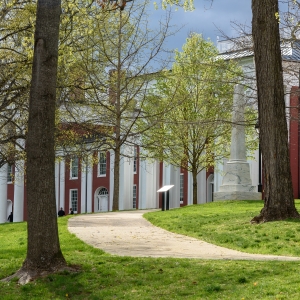
W&L Announces New Fixed-Term Faculty, Fellows and Assistant Coaches
Twenty-eight new faculty and staff members are joining the university this year.

W&L’s Hamza Zia ’26 Awarded FAO Schwarz Fellowship
Zia will complete a two-year fellowship at Reading Partners nonprofit in New York City.

To the Moon and Back with Andy Scott ’99
Scott, systems analysis integration lead for the Orion program at Lockheed Martin, shares about his role in the Artemis II mission.

W&L’s Aiden Gray ’27 Awarded Goldwater Scholarship
Gray’s funded research will focus on autonomous oceanographic systems and materials science.

Aeron Tynes Hammack to Deliver Lecture as Part of the Class of 1963 Scholars in Residence Program
Hammack’s talk will be held March 26 in Science Addition 214.
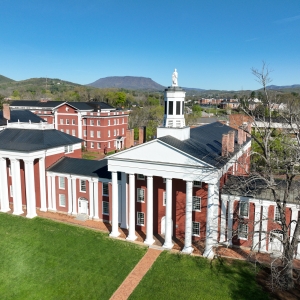
Washington and Lee Seeks Accreditation for Engineering Program
It is anticipated the Class of 2030 will be the first students eligible to earn an accredited engineering degree from W&L.

Mengying Liu to Present Nobel Prize Symposium Talk
The assistant professor of engineering will discuss this year’s Nobel Prize winners for chemistry on Jan. 15 in Leyburn Library.
Two W&L Students Awarded Gilman Scholarships to Study Abroad
The Gilman Scholarship Program offers awards of up to $5,000 to U.S. undergraduate students who are Pell Grant recipients.
Mengying Liu receives The Minerals, Metals & Materials Society Early Career Leaders Professional Development Award
The assistant professor of engineering is one of three recipients recognized globally.

W&L Outcomes: Cat Caples ’25
After making connections through the W&L alumni network, Caples will be working as a mechanical and design engineer at Hardwire LLC.
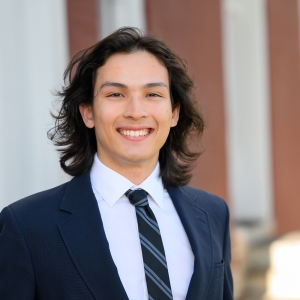
W&L’s Thomas Leggett ’25 Selected for Fulbright to Taiwan
Leggett received a Fulbright English Teaching Assistantship to teach English in Taiwan and plans to pursue a career in civil engineering.

American Dream
Tolu Olubunmi ’02 has made her journey to citizenship an opportunity to inspire and serve others.
Meet the Faculty
At W&L, students enjoy small classes and close relationships with professors who educate and nurture.

Tom McClain
Associate Professor of Physics; Interim Department Head
- P: 540-458-8294
- E: mcclaint@wlu.edu
Professor McClain teaches General Physics for first-year students. His research interests include quantum theories of gravity, gravitational wave astronomy, philosophy of physics, and mobile and cloud-based physics simulations for education.

Paul Aiken
Visiting Assistant Professor of Engineering
- P: 540-458-8850
- E: paiken@wlu.edu
Paul Aiken teaches courses in electrical circuits, analog and digital electronics, and introduction to engineering.

Emma Aldrich
Visiting Assistant Professor of Physics and Engineering
- P: 540-458-8814
- E: ealdrich@wlu.edu
Emma Aldrich teaches courses in general physics.

Jonathan Erickson
Professor of Physics and Engineering
On Leave
Erickson’s courses include Physics and Perception of Music, Electronics, and Bioengineering and Bioinspired Design. His research interests include biomedical signal processing for gastrointestinal electrical activity patterns. In his Bioelectronics Lab, students develop electronics hardware and software algorithms to measure dynamic patterns of electrical activity in the gastrointestinal tract.

Joel Kuehner
Professor of Physics and Engineering and Director of Engineering
- P: 540-458-8153
- E: kuehnerj@wlu.edu
Kuehner teaches courses in entry-level engineering, mechanics, thermodynamics and fluid mechanics. His recent research focuses on periodic water flows and oscillatory natural convection to uncover the causes of periodic behavior. In his Fluid Diagnostics Lab, research examines turbulent mixing mechanics. Students acquire flow properties such as temperature or velocity using laser-based methods that do not disturb the flow.

Mengying Liu
Assistant Professor of Engineering
- P: 540-458-8599
- E: mliu@wlu.edu
Mengying Liu teaches courses in materials and mechanics. Her research background is in hydrogen embrittlement behavior of alloy 725, investigating the localized plasticity on the surface of the hydrogen embrittled materials in situ with scanning electron microscope. She received her Ph.D. in Materials Science and Engineering from Texas A&M University.

Dan Mazilu
Department Head; Professor of Physics
On Sabbatical – Fall 2026
- P: 540-458-8172
- E: mazilud@wlu.edu
Mazilu teaches courses in general physics, classical mechanics, electricity and magnetism, and special topics in contemporary physics. His research interests include experimental and theoretical studies of self-assembled nanoparticle monolayers, as well as interdisciplinary projects in the field of complex systems.

Irina Mazilu
Ruth Parmly Professor of Physics and Engineering
On Sabbatical – Fall 2026
- P: 540-458-8171
- E: mazilui@wlu.edu
Irina Mazilu teaches courses in general physics, statistical physics, nuclear physics and computational modeling of physical systems. Her current projects include nanoparticle self-assembly and applications of statistical physics to social sciences.

Poorya Shobeiry
Visiting Assistant Professor of Engineering
Poorya Shobeiry teaches courses in engineering. His teaching interests include mechanics, engineering graphics, MATLAB programming, engineering mathematics, and control systems. He is particularly interested in helping students connect engineering theory with practical applications through computation, modeling, and design.

David Sukow
Professor of Physics
- P: 540-458-8881
- E: sukowd@wlu.edu
Sukow’s courses include Stellar Evolution and Cosmology, Modern Physics, Optics, and Quantum Mechanics. His research involves nonlinear dynamics in semiconductor lasers, and is beginning to include astrophysics.